Tuesday, June 11, 2013

2013 Kettle 100 Adventure, Race Report (2 of 3)

This is the second of three posts on this subject, with the final entry to focus on my nutrition.

At some point last year, it became apparent that “it was time.”  I had put this off long enough.  50 miles no longer felt “far.”  I needed to challenge myself, and maybe feel the bite of failure again.  It was time to sign up for my first 100 mile trail race.  Enough of the short-course shenanigans, it was time to step up with the big boys.

When it came time to selecting that race, there was no real decision to make; it would be the Kettle 100 in the Southern Wisconsin portion of the Kettle Moraine.  This race is held mainly on some of the greatest singletrack in the Midwest, on the 1000-mile long Ice Age Trail (IAT).  This race includes about 8,000 ft of elevation change, which makes it a relatively flat 100 miler, so I thought this might help me to ease into the distance.  The only downside seemed to be its spring scheduling; I've never had to train through winter.  Training went fine though, as I learned to tromp through snow and ice.  In fact, I thought spring would never come.

But come it did, and soon enough it was time to lace up my shoes and try something that would again push my limits.  Several friends and family members requested to follow my progress through text updates by my wife and crew, Beth.  I found this very touching; I was really humbled by the interest.  Thanks.  I hope you found the drama interesting.

The Kettle 100 is a double out-and-back course.  Starting at the Nordic Station in La Grange, WI, the first section starts on 7 miles of ski trails, and then travels 25 miles north on the IAT to Scuppernong, for an out-and-back total of 63 miles (or almost 100k).  The second section starts on the same 7 miles of ski trail, but then turns south for 12 miles to the Rice Lake turnaround, providing a total course length of about 101 miles.

There are four races held on the course.  The first three start simultaneously: 100 mile solo, 100 mile relay, and 100k.  The final 38 mile “fun run” starts some time after 6:00 pm, and helps to keep the 100 milers company on some lonely stretches of trail.  My goal was an average 12 min/mi pace for a 20 hour finish time.

We picked up our race packets the night before, so all we had Saturday morning were the usual victuals and expendables.  This was a very low-key start line, rife with nervous energy.  I met a few great people here, but none seemed able to focus on much of a conversation.  We had all prepared hard to get to this point.  Let’s get this thing going!

And, soon enough, it was “ready, set, go.”

I started out at 10.5 min/mi, a pace a bit faster than I had planned, but his was the pace of the crowd and I went with it.  The first 7 miles of ski trails were not fun.  They were wide and boring and very hilly.  Not much elevation, but full of Pointless Ups and Downs (PUDs).  Our first aid station, Tamarack, came in about 5 miles.  I don’t really remember much other than filling my water bottle, grabbing a gel, and hugging my sister who was volunteering here.  Have some stinky sweat Sis!

The first crew-access aid station was only 2.5 miles further at “Bluff”.  Here Beth handed me my first bottle of UCAN, and a gel.  We’ve gotten good at the pit row aid station method: Beth and I swap bottles, she hands me what else I might need, I tell her what I might need ready at the next station, and I’m off.

The next 8 miles were fairly hilly singletrack.  Very pretty and just a little technical.  I kept my 10.5 min/mi pace going comfortably, and the miles ticked off.  After an unmanned water stop at Horse Riders, I was at the first out-and-back half way point; Emma Carlin.  This was one fantastic aid station.  Tons of people!  I loved it.  But soon enough, I was out of there with another bottle of UCAN and some gels.

This section of the course was my favorite.  Everything was fresh in the spring morning, including my legs.  A decent-sized group of us formed a Zen-like conga line though the forested singletrack, effortlessly zooming through the stony ups and downs, feet knowing, without thought, just where to plant.  A grove of flowers unexpectedly appeared at this point, wrapping the moist air in a blanket of sweet fragrance.  I wish I could bottle up this emotion and uncork it whenever someone questions running such distances.  I could not image being anywhere else.

Then, of course, I fell flat on my face.  No blood though, and I quickly caught back up with my friends.

The next section had a fair bit of open prairie and was relatively flat.  As the heat of the day had yet to set in, the 10.5 min/mi pace continued easily.  I knew this section had a reputation for being hot, so I was prepared to slow it down some on the return leg; but not yet.  I did get a chance to meet a guy with an Aussie accent.  He was searching for his wife’s iPod, which he had dropped on the trail.  A few of us searched in vain, but then it was time to skedaddle; Hwy 67 came soon enough.  Through this part there were many sections of unavoidable mud and muck.  These can suck, and I tried to ignore them, plowing right through and trying to maintain my balance.

After Hwy 67 we got another good dose of hills, but at least this area was fairly wooded, so there were really no heat issues.  I had other, more pressing issues to contend with at this point though.

Having run this section of the IAT a kajillion times, I thought I knew exactly where the Hwy ZZ aid station was located; at the same location as the North Face Hwy ZZ aid station of course.  So, instead of following the well-marked course, I made a bee-line to (what turned out to be) my imaginary aid station.  After coming down a hill, and not seeing an aid station where I thought one should be, I continued until I saw one across the street.  Whew!  I thought I had gone off course.

Funny, Beth wasn't there; the first crew-access aid station she’d missed.  I know my pace was still 10.5, so I must be too far ahead of schedule.  I’ll see her at the next station, the Scuppernong turn-around, for sure.  So I refueled and took off down the trail.

Funny, there are a lot of very fit looking people running towards me on the trail.  Well, either I was moving pretty fast, or I was where I shouldn't have been.  Sure enough, I had missed a turnoff and bounded confidently into the Scuppernong aid station, skipping Highway ZZ.  Bummer.  But I had a plan.  Since the Hwy ZZ to Scuppernong was an out-and-back, the section is run twice.  So after Hwy ZZ, all I needed to do was double-back to Scuppernong, plead my case, and run this section again.

Of course, Beth thought she had lost me.  She was speaking with the course monitors trying to figure out where I had last checked out.  I met her again on my second trip to Scuppernong.  She was relieved, but worried that I would be DQ’ed.  That would have sucked.  Bet the RD, who felt that if I was not top-3, I could continue, as long as I travelled the same distance, albeit a bit in the wrong direction.  Thank you.

It was weird to be at about 30 miles in a 100 mile race, feeling fantastic, and keeping pace.  There was no “central fatigue” with which to deal, and no tired legs.  I felt like a million bucks.  This thing will be a snap.  Ha ha.

Returning to Hwy ZZ, there are sections of switchback singletrack.  Since this was an out-and-back section, I met quite a few runners.  They were very courteous, yielding to the out-of-control downhill runners.  These downhills were a blast.

In and out of Hwy ZZ with a fresh UCAN, I ran with relative ease to Hwy 67.  The sun had finally shown its face, and as it had been raining quite a bit the week approaching the race, the humidity would become an issue.  But not yet.  I was still on a 10.5 min pace and feeling comfortable, with a bit of leg fatigue.  At Hwy 67, I took a lot of ice with my UCAN, and wrapped an ice-filled bandanna around my neck in preparation for the open prairie section.  This did the trick.  It was hot and humid, but the cool bandanna and ice kept me cool.

I slowed my pace significantly through the prairie towards Emma Carlin.  I knew the hills that were to come, and running at the faster pace in the heat would not have been prudent.  Still, I felt pretty good coming into Emma Carlin.  So with a quick refuel and kick in the butt, I was out of there and back into the cooler (so I thought) forested section back to Bluff.

Funny thing, but the humidity seemed to be trapped under the forest foliage.  I sure was feeling it here, both mentally and physically.  The PUD hills and humidity were wearing me down.  My legs were not tired, but everything else became a burden.  I found myself slouching, with very sore shoulders and back.  The miles, which ticked off so easily before, now seemed to double in length.  And the UCAN, which was giving me a steady drip of energy throughout, started making my stomach feel bloated, like I had just eaten 500 pretzels.  Coming into Bluff, I was in a sorry state.  Beth wrung sponges of ice water on my back, which helped a lot.  Food looked worse than the UCAN so I continued with the same fueling schedule.  I vowed to revive my negative attitude into Nordic.

To counteract those negative feelings, Beth and I planned on a sock change at Nordic.  A pick me up.

And then I was out of Bluff and headed back to the Nordic start-finish to start my second out-and-back.  I lost a bit of my sanity on that 7 mile stretch.  What once felt totally doable now seemed unfathomable.  My brain was wreaking havoc, and I was unprepared for the lengths my it was willing to go to get me to stop.  My legs were fine, yet I couldn't imagine running a measly 38 more miles.  After what seemed like hours, I came into Nordic in a terrible mental state.


I was miserable, my stomach felt worse, my back and shoulders were killing me, and I sat down to change my socks.  Big mistake.  Terrible mistake.  Fatal mistake.  I should have changed my stupid socks at Bluff!  I wanted to quit in the worse way.  I started to shiver, and nausea was wracking my body.  What I needed to do was get back moving again; to get the leg-heart system back in gear.  Walk to the next station if need be, and quit there if I still felt so compelled.

And then the heavens opened, sealing my mental fate.

I told Beth that “I don’t want to do this anymore.”  I turned in my timing chip and left, feeling dejected.

I really had no reason to be so morose.  I had just run 63 miles, by far my longest single distance to date.  My legs held out fine and could have continued.  But I quit, and I wished I hadn't.  I learned a TON though (see previous post), whose lessons I plan on applying to next year’s race.

I ran the race using a single waist-pack water bottle, usually filled with UCAN.  My shoes were my trusty Inov8 F-lite 230's.  I've been using this model for the last 5 years, and they are still my favorites for hard-packed singletrack.

Thank you all to the fantastic RD, wonderful aid station volunteers, everyone who was following my progress, and of course my wife and crew, Beth.  It was a fantastic experience, and even though I failed to finish, I am aware of the wonderful gifts God has provided.  We’ll get ‘er done next year!

Tuesday, June 4, 2013

2013 Kettle 100 Adventure, Lessons Learned (1 of 3)

This is the first of three posts on this subject, with the next two to focus on the race report and my nutrition.

The thing I like about writing this blog is that it allows me to relive and share some very good races and wonderful experiences, while conversely providing me the vehicle for putting some unsuccessful experiences behind me.  Get it out on paper (or pixels in this case), and then shift focus on what’s next.

I DNF’ed at mile 63 of the Kettle 100 mile race, my first attempt at this distance.  Surprisingly, I am not as devastated by this result as I might have expected.  I learned a ton just getting to that point in the race, all of which I plan on applying to my next attempt at this distance; probably in the same race next year.  So without a further waste of pixels, here’s what I learned.

1.    Running 100 miles is friggin’ INSANE!  I had no clue.  Everything I experienced in this race, I've read about previously; there were no real surprises.  But to experience it is to know it I guess.  The mental aspect of racing this distance is one for which I was not prepared.  My body did not fail, but my mind was left reeling.  This aspect is one for which I must be better prepared.  I have a whole new level of respect for those who can finish at this distance.  Mary, you rock!

2.    Steve Quick warned me!  Beware the chair at mile 63.  I had the great idea that changing my socks at this point in the race might be a great pick-me-up.  But I need to sit for that to happen.  Big mistake.  I was too close to the car, to a George Webb’s burger (which WAS delicious), to warmth and comfort and family, and anything other than running.  Why did I sit down?  Once I made that decision, it might as well have been the Kettle 1000.

3.    I need to have a plan.  Prepare for the lure of the chair!  If I am dead set on quitting, then quit at the next aid station.  Maybe caffeine might give me the boost I need.  Or music.  Or maybe a cattle prod.

4.    Running 100 miles on hill and trail was hard on my whole body.  Afterwards I felt like I had been rolled in an alley by some thugs; big ones with bats.  And tattoos.  In the months of training leading up to the race, I focused almost entirely on leg strength and endurance.  That part of my training worked.  I still was able to run the uphills and downhills relatively comfortably late in the race.  My back and shoulders were very fatigued.  I can get away without push-ups and planks for races less than 50 miles it seems; but not at this distance.

5.    Screw the goal time, just finish my first 100 miler.  I had set a goal time of 20 hours.  I know I can run that time, and I will some day.  But this was my first attempt at this crazy distance.  Setting a goal this aggressive applied too much mental pressure.  Next time, just finish the darned thing.

6.    With that said, I still need to plan a pace.  I set out at a 10.5 min pace for the first 40 or so miles, and I don’t think that hindered me at all; I don’t think I started out too fast.  I was comfortable at that pace, allowing me to slow it up when the heat became more of a factor.  I have a feeling that once the coolness of the evening set in, I could have returned to at least an 11 min pace.

7.    At locations late in the race in which DNF'ing is uniquely convenient (i.e. the 63 mile turnaround at the Kettle 100), plan on a u-turn.  Do not linger and allow naughty thoughts to develop.

In conclusion, for those who are considering this insanity, I hope this helps.  For those who are already nuts and have completed this distance, I would love to hear your input and guidance.  The bottom line is: I could have continued.  I did not.  I wish I would have.

The actor Peter Ustinov once said, “The point of … being an optimist, is to be foolish enough to believe the best is yet to come.”  Well, I'm understating the obvious when I say that trying this again will be foolish.  Here’s to what’s yet to come!

Friday, May 24, 2013

Kettle 100 Jitters

In one week I will be somewhere on a lonely stretch of singletrack in the Southern Kettle Moraine trying to do something that I find pretty intimidating; something that is simply an unknown for me.  I am going to try to run 100 miles in one day.  Thousands of people do this every year and they aren't falling apart from the experience.  I know I can do this too.

My trepidation comes from that unknown quantity; it’s always the unknowns that give us pause.  Will my body keep it together, or will it let me down?  I know my body will be aching for sure, but how will my mind handle the experience?  Will I be able to while away the miles, or will each stride be a step closer to going absolutely nuts?  Will I see monkeys?  Will I barf?  Will I yell at my crew?  Will I get a (gasp) blister?

Tapering for my first 100-miler has become a pretty nerve-racking experience.  I can’t imagine life past 6:00am on June 1st, 2013.  Part of the deal is, I am as prepared for this race as I can be.  With a high-fat, low-carb keto-diet, I am a lean & mean racing machine at 140 lbs.  I've been putting in the miles and hammering the hills for the last 5 months, through snow, mud and rain.  I've also never been this uninjured and healthy in preparation for a race.  My energy levels are fantastic, and my legs are pretty tough.

I know I’ll be fine.  I will feel like a million bucks after I cross that line sometime on June 2nd, and all those questions will be answered.  It’s going to be long, and rough, and hard, and painful.  But it will be nothing I can’t handle.  Unless there are clowns.  Then I’m done for.

Thursday, May 2, 2013

Not so fast Spring: A Winter Encore!

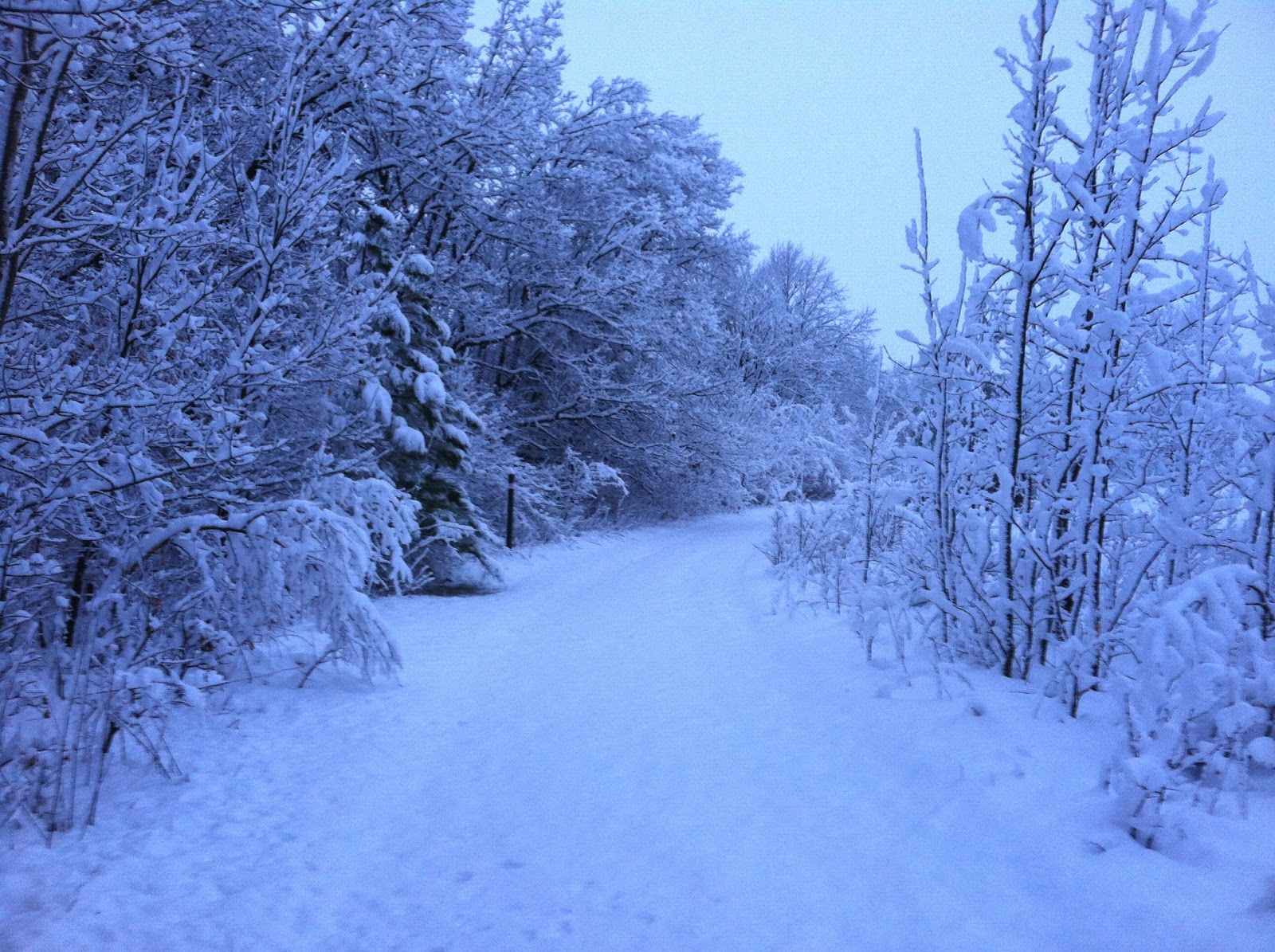
As luck would have it, Winter was NOT done in Wisconsin.  Another dumping of about 6" of snow found Willow River State Park on the morning of May 2nd.  I love running in this state.

I took the following pictures on my morning run in the park.  With scenes like these, Spring can take its time.  Enjoy!

The path into the park; 6 inches deep!

The steps to the North observation overlook

The view from the overlook; the picture does not do the scene justice

Willow River, at the Falls Bridge

Tuesday, April 23, 2013

One Last Winter Gift at Willow River

I've never been forced to train through the winter.  Ever.  I've always chosen to peak for fall races, giving me the summer to train properly.  This is more about perceived limitations than toughness.  I just never considered winter  as a time to train.

When it came time to choose a first 100-miler, I wanted something fairly straightforward, flatish, close-by and familiar.  The obvious choice turned out to be the Kettle 100 in S. Wisconsin.  I know and love the Ice Age Trail in this area. Fantastic running, beautiful scenery, and (mostly) non-technical singletrack.  The trouble was though, that it runs the beginning of June.

This early race forced me to train through snow and sleet.  Through 6" of snow and very uneven footing.  At 5:30 in the morning with a headlamp.   I refused to run on the roads in training for a trail 100-miler; that would make no sense.  I am now emerging from winter pretty tough and fit, and uninjured.  Relatively of course.

One unexpected gift that came my way was "the things you see" when you run at all times of the day and year.  This morning was no exception.  It is the end of April.  Average high temps are supposed to be around 60°F.  We are expecting to see the sun and 75° by the weekend (woo hoo!).  And yet, God saw fit to give us one more winter gift in the form of about 8" of freshly-fallen snow overnight.

I was out on the trails at Willow River State Park in NW Wisconsin this morning, at about 5:45 am., and took these pictures.  Enjoy, and happy end of Winter!


Friday, March 15, 2013

Ft Lauderdale A1A Race Report

The A1A weekend brought three St Croix Valley runners—Randy, Steve, Candy—and a couple of their friends together for a great time. Captain Randy was a gracious host, coordinating dinner reservations/locations and race logistics.

Lady Chateau
The runners and their support teams met on Randy’s Lady Chateau before heading out for a pasta dinner on Saturday night. A discussion about race logistics and our departure time from the hotel the next morning turned into a bit of a negotiation between Randy and Steve. As always, Randy wanted to get to the start line about an hour before race time. That gives him enough time to take in the crowd, drink some extra fluids, and revel in the atmosphere. Steve, on the other hand, prefers to step out of the vehicle and into the running queue, getting all the beauty sleep he can and wasting no energy on frivolous, pedestrian activities. As it turned out, we were very early and it got to be uncomfortable standing in that cold, blustery wind.

The Runners--Steve, Bobbye, Candy, Randy, Juliana

The Support Team--Jerry, Robin, Gary
The weather conditions for the 6:00 am start were much cooler than in past years. The temp was 45° F at the start, or 38° F with the wind chill due to a 17 mph wind out of the north. This was a bit of a concern because the route for about 11 miles of the marathon and 4 miles of the half was straight into the wind.

Staying warm--Bobbye, Steve, Juliana, Candy, Randy
The first priority during those early morning hours was staying warm. The high temperature for the day was somewhere in the 60s.


Randy placed second in his AG in the marathon and friends Juliana and Bobbye nailed down PRs in the half. Steve ran the half with Juliana, and Candy managed to drag her butt across the finish line logging one of her slowest times. All were very interested in Candy’s time in that she was trying a new training technique. It’s the Hanson-Brooks method, and for those unfamiliar with it, they stress running on tired legs with the longest run at 16 miles. She followed the program pretty well, but a bout with the Minnesota “crud” wasn’t on the schedule, and she found the running against the cold wind quite challenging.

Randy expanded his host duties on Monday by taking our merry group on a boat ride along the Intracoastal Waterway. Among the notable things to see was Steven Spielberg’s yacht that is parked a dock away from the Lady Chateau.

Cruising the Intracoastal Waterway--Bobbye, Candy, Robin, Juliana (ouch that is sunburn) 
The Spielberg yacht--complete with indoor swimming pool
Thank you Captain Randy for the Ft. Lauderdale adventure!

Wednesday, March 6, 2013

The Adventures of Keto-Man


The end of 2012 found me contemplating my previous racing season.  It was a great year of ultra-marathons, with multiple PR’s, an AG win and almost a top-10.  I was left with the feeling though, that “this was it”, I just can’t get much faster or better and it will be all downhill from here.  I am 48, so that day is looming I’m sure.
But.  I still have one card yet to play.  My diet.  I've always just eaten anything and everything.  Why not when you run 70 mi/wk, right?  Well, after reading ZachBitter’s blog on low-carb performance, I thought that was well worth investigation.  My long race performance (> 50 mi) sure could use some improvement.  Too many bonks with too much central fatigue.
I went out and bought The Art & Science of Low-Carb Performance by Stephen Phinney and Jeff Volek.  I have now been officially keto-adapted for 8 weeks and I’m no longer looking back to my old diet.  I eat <50 g low-glycemic carbs/day, a set amount of protein, and enough healthy fat to manage my body weight.  Here are some of the results I've found in my short experiment:
Energy Level – I considered the spikes and lows of carb-based nutrition as just normal every-day life experience.  Not so as keto-man!  I feel awesome!  My energy levels are even all day long, with no afternoon slumps.  During long runs, I experience about an hour of slight soreness in my legs, and then no significant discomfort after.  Without fueling.  My longest run so far has been 4 hrs, so what happens beyond, we’ll see.

Recovery – Wow. This is the area where I am seeing the greatest improvement.  I used to really feel a 4 hr run for at least 48 hrs.  Now it is just a dull ache for about 12 hrs, and I am ready to go the next day.  This is good, because I want to be doing closer to 100 miles/week max in training for a 100 miler.
Explosive Power – I find that I might have a little less explosive power available.  I am still in my base training phase, and have not started speed-work yet, so this may not be the case.  But.  I do stair training every Tuesday morning, at the 250 ft Willow River falls stairs.  Last year, as a carb-fueled person, I would lunge every-other step for the first 125 ft, and then run each step of the remainder.  This year, the lunges seem to me a bit more difficult to maintain, and I’m dying more at the end.  We’ll see though.  It may be too early to tell.
Body Weight – I can’t keep it on!  My racing weight used to be around 150 lb at about 14% fat.  Training weight was about 155-160 lb.  Today, I am running about 50 mi/wk at 142 lb and 12% while dropping about 2 lb per week.  The real bummer is that I don’t seem to be adding lean muscle mass yet.  I’m not sure what is going on.  I do think that, for being in a training phase, I weigh too little and need to pack on a bit more to my 6 foot frame.  More fat I guess.
The Role of Carbs in Racing – I am convinced that I can run a race while maintaining the keto diet.  Supposedly the Vespa supplement could help me, but it is so dang expensive.  Others speak of using super-starch, like U-CAN, which slow-drips the carbs into your system.  Zach Bitter mixes his carb gels and Vespa while racing for optimal performance.
I am convinced that carbs will play a role in my races.  I will start experimenting with U-CAN after my long runs reach about 5 hours or so.  I’ll try some gels too, to gauge their effect.  From what I read, I’ll want to avoid the insulin response.  Hmmm.  At mile 90 I’m thinking the Expresso Express gel might be what the doctor ordered.  Or, I might drop from a coronary.  We’ll see.
Favorite Food – Steak, duh.  My second favorite is a shake though.  Add the following to a blender, in this order:
                1/4 cup blueberries
                1/2 cup Greek yogurt
                1/2 cup cream or half-and-half
                1/4 cup whey protein (peanut butter works too)
Blend to consistency.  Pour into glass.  Add the following to the glass (this will gunk up your blender, so add it here):
                Olive oil, or fish oil to taste
                1 TBSP chia seeds
There is a wonderful blog written by three (now four!) keto-adapted athletes called runketo.com, where I have found some great info to aid in my diet adventure.  There are many links to other keto-friendly blogs there as well.
I know I am an experiment of one, but the results look promising!