Tuesday, July 23, 2013

Ice Age Trail, Straight Lake Segment 40 mile Lard Ass


A "Fat Ass" is the name given to a low-key, by-invitation run without fees, awards, aid, course marking, guarantees or zombies.  It can be a race, or just a social event.  A course, a date and time, and some friends.  But, if I have no friends, is it still a "Fat Ass"?  Maybe then it's a "Lard Ass" or something.  I guess I'll use the time I have left to make some friends I think.

I guess I don’t care, I’m doing one anyway.

Due to sucky budget issues, I’ve pared down this year's race schedule to the bare minimum, which leaves 16 weeks between Afton and Surf theMurph.  I can’t train 16 weeks for a 50 mile race, I would die a training death of a thousand screams, or go bananas from being so bored.  Soooo, instead of taking the next 8 weeks off, I've planned a 40 mile run along a segment of the 1000-mile IceAge Trail in northern Wisconsin at about the end of August.  I’ll treat it like a race, with base build up, heat and speed training, an injury or two, and a taper.  Also, my wife Beth will provide the mobile munchy wagon, meeting me at key road crossings.

The route I've selected includes about 40 miles of very hilly singletrack on the trail.  This trail travels along the furthest extent of the last ice sheet to bother Wisconsin in the last 10,000 years, and as such, is full of many interesting terrain features, such as eskers, drumlins, kettles and kames.  Read here for more on my experience running the southern portion this trail.  The section I will be running will be Leach Lake Road (mmm, sounds inviting) to the StraightLake State Park parking area.

The Driftless Area

As a side note, just as interesting as the ice sheet boundary in Wisconsin is, the region the glacier missed is even more incredible.  The southeast corner of Wisconsin is known as the “Driftless Area”, or “Paleozoic Plateau”.  Take a look at a terrain map of Wisconsin, and you’ll see what I mean.  River valleys are deeply dissected (up to 650 feet), and are characterized by steep coulees.  The area is so rugged, a portion of it is known as the Ocooch Mountains, with exposed 1.6 billion year old monadnock (not the disease. it sounds like a disease. or a prescription medicine that can cause frequent urination).

The Driftless Area begs for a Superior Hiking Trail-like corridor, but alas, is pretty undeveloped.  In fact, maybe it’s better that way.  If you are interested in visiting this area, I would recommend the following points of interest from personal experience:
  • Camp at a state park:
    • Devil’s Lake – reserve your spot early, this is the largest and one of the most popular of the Wisconsin parks
    • Wyalusing – get one of the bluff tent sites, incredible view, especially at night
    • Wildcat Mountainthe wildcat did growlll
    • Governor Dodge – big and beautiful in the fall, a family favorite
  • Boat the Wisconsin River, east of Mazomanie – camp on a sand bar (no bugs), fish the river (always a huge variety)
  • Bike the Elroy-Sparta – bring a flashlight, this is one of the best rails-to-trails in the country with awesome scenery and several loooong tunnels
  • Canoe the Kickapoo – lazy, winding, beautiful, and a great swim too; lots of outfitter options
  • Have dinner at Di Sciascio’s in Coon Valley – this place is the proverbial “hole in the wall”, the exterior looks like a bar, but the food is fantastic; you won’t believe me when you see it and will be tempted to move on; don’t!
  • Spend the night at the Westby HouseB&B – this is probably the best B&B in the Driftless Area.

But, back to my Lard Ass (run)
I’m not sure what to expect, or how best to prepare, so I think I’ll take a cautious attitude:
  • Since we do not know this area very well and I may miss an aid drop (or get really lost), I’m thinking a hydration pack would be smart, over my usual 20 oz bottles.  Maybe a few iodine pills and Kool-Aid too.
  • Due to patchy logging and some private land crossings, the trail might be difficult to follow in some areas.  I am getting the latest Ice Age Trail Atlas and Companion Guide from our library.  I do NOT want to get (too) lost.
  • I’ll bring my smartphone for sure.  Other than the talky thing, this will be good for pictures at least, and I can use a breadcrumb app to track my progress.
  • Should I go fast or slow?  Slow makes for a more enjoyable journey, but fast equates the race for which I’m pretending to prepare.  Maybe a combination; fast when I feel like it, and then slow when I want to take a picture of a squirrel or enjoy some scenery or something.

Should be a fun adventure no matter what happens!

Thursday, July 11, 2013

2013 Afton Trail Run 50k Race Report

Wow.  Another year passed, and another great Afton 50k in the books.  The years for each of these great races don’t really seem to blend together though.  Each seems to stand out for different reasons; usually due to the weather, or sometimes course changes.  I remember the unreal heat and brutal ski hill course in 2011 (cursed Republicans), the gentle rain which kept things cool in 2009, etc.  This year may not stand out for many though.  The weather was pretty standard and the course had only one minor change.

It will stand out for me.

This will be known as the year that I tried something new on race day when you’re NEVER supposed to try anything new on race day.  This will be the year I had to gut it out, because I made a simple, stupid mistake.

A quick overview of the Afton trail Run…  This race has been held at Afton State Park in Minnesota for the past 20 years or so.  25k and 50k distances are offered, depending on whether you traverse 1 or 2 loops through the park.  The trails range from gravel road to singletrack, from wide open prairie to dense forest, from railroad bed flat to eroded washout climbs.  This year 400 folks opted for the 25k distance, while 200 braved the 50k.

What I like about this race, and what keeps me coming back (aside from the organized crew that runs the event) is that it is challenging: hot, hilly and fast, but not too much of each.  The terrain and scenery changes throughout the course, keeping the day interesting.

Race morning started like most: the beeping alarm, zombie motions out of bed, getting into some snappy getup I laid out the night before, a quick drink of water, and a spoonful of cream cheese.  Actually, that last part was new for this year.  I read somewhere that a bit of fat before a workout stokes my fat-burning furnace and allows me to hit the trails harder minus the sluggishness.   Hmmm.  We’ll see.

Check-in was as smooth as ever.  The volunteers at this race are pros (except for the lady who tried to give me someone else’s timing chip).  No early morning food though.  With the diet I have been adhering to recently, I avoided taking on calories before the race; I wanted to get that fat-burning furnace going.  I did have a slight knot in my stomach though; must be pre-race jitters.  We then ambled towards the start area about 15 minutes before the gun.  I carried a single 20 oz. water bottle on a waist pack; simple and light.

Following a quick pep talk about Afton State Park (a portion of our race entry fee is donated to the park) and hydration (it might get pretty hot out there), I worked my way towards the front of the pack of runners waiting for the start.  I’ve found that things can get pretty crowded near the back as the trail narrows a bit.  I found Chris Lundstrom grinning and greeting other runners; I was unexpectedly next to trail running royalty!  And then we were off.

Three things were evident as we started down the initial chute:
  • I was right where I needed to be in the pack, as runners started to spread out a bit in front of and behind me.
  • The heat was noticeable from the start.  I think it was in the low 70’s F, which was a bit warmer for 6:30 in the morning than in the days leading up to the race.  I was hoping heat would not be an issue until the second loop.  Not so this year.
  • That knot in my stomach exploded into full Alien mode as I was jostled on the quick descent.  Pre-race jitters generally go away when the gun goes off; this was something different.  This was that spoonful of cream cheese.  Crap!  Well, the pain wasn’t debilitating, so I kept the pace.  Maybe the Alien would hatch and go infect someone else.  Ha ha.

In past Aftons I tended to run a pretty strong first loop, while flagging the second loop by quite a bit.  This year I decided to hold back a bit initially saving for a stronger second loop, and hopefully a faster time overall.  It was 5 minutes into the race and I was sweating already.  Dang.

Following the initial drop, we climbed to the Africa loop, a forest-bordered prairie-like section of parkland complete with swaying grasses and flitting microfauna.  A slight breeze kept the runners from getting too hot as we circled the southern portion of this trail.  Warmup over, I got my pace up to about 7:30 miles as the runners spread out along the path.  Me and my cream cheese grenade felt good.

Unlike my previous Afton race reports, I’ll skip the course blow-by-blow.  Please read here for a description of each course section.

During the first loop, I kept a nice even pace, I felt good (though a bit warm), though my stomach was killing me.  Any time I pushed the pace, or bombed a downhill, I was reminded about how the crew aboard the spaceship felt in the movie Alien; the ones stupid enough to want to get a close look at that nasty thing with crab legs.  It was a weird feeling to have that much pain, while all other systems were functioning fine.  I successfully pushed Alien aside for the moment, but it did take some of the fun out the moment.

It was now that I noticed another mistake: It was evident I ran too hard 3 days prior to race day.  The Wednesday speed workout in the heat went too hard, and for too long.  Those specific muscles that ache after those types of runs were still hurting.  Oh well, not much I could do about that at the moment; something to add to the “don’t do this again before a race” list.

I took on no calories during the first 15 mile loop, running mainly on my onboard store of carbs and fat.  I did, however, keep the ice in the water bottles, and took several electrolyte tablets.  I came in to the start/finish for a quick turn-around, and then was down the chute for my second go-around.  First loop went at about 2:20.

On the second loop, heat became more of an issue.  To combat this, my wife/crew Beth handed me frozen bandanas to wrap around my neck, and frozen washcloths for placing under my hat.  Near the end of the race, I started pouring ice down the back of my shirt as well.  This strategy worked well for me as I suffered no heat-related issues or central fatigue during the race.  The temperature did get up to the mid-80’s I think.

It was on the second loop where I started to take on some calories.  Not much though.  I think I had 2 gel packs and a packet of UCAN in one of my 20 oz bottles.  I’m still experimenting with limiting my carb intake during races.  Fast-acting gels tend to provide a good hit during faster/shorter 50k’s, while the steady drip of energy provided by the UCAN seems to be more effective in the longer, 50 mile+ distances.

Another feature for this year was that, I was running alone for most of the second half of the race.  In previous Aftons, I almost always had someone nearby on the trails.  This year there were times I felt I was lost.  I saw very few 50k racers following Aid 2  There was a portion of the Africa Loop where I could see no one in the front or rear of me.  I did start to catch the back of the 25k pack after Aid 3 though, so I must have been on course.

After climbing out the Meat Grinder for the second (and last) time, and looking forward to another go at the Snowshoe Loop, I started to have some fun.  The Cream Cheese Alien was still snarling, but I had, by then, mentally pushed that issue aside.  My body was aching, I was hot, and I was ready to be done, but I was still running strong.  By now I could smell the roses, but part of me did not want the run to end.  Besides, the Snowshoe Loop is a blast to bomb.

Coming out of the Snowshoe Loop, there is about a half mile of straight and flat to the end.  I poured on the speed here and ran strong to the finish.  Unknown to me at the time, I was very close to breaking 5 hours.  I’ve never been cheered like that into a finish.  That was fun.  I came across the line at 4:59:22.  Not a PR, but I was still very happy with the result.  Thanks Mary and Mel for coming by to watch the finish!

Stillwater Runners Wayne M., Dave M., and Tom A. all completed the 25k race.  What can I say about Chris Lundstrom?  3:40 is a rockin’ time and a course record.  That’s a 3:05 marathon pace with 4,600 or so feet of climbing.  Simply awesome Chris!


Thanks again to the legions of great volunteers who put on this great race.  Thanks to Afton State Park for allowing the event to take place in their beautiful park.  And thank you Beth for sharing these experiences with me and getting me through the aid stations quickly.

Tuesday, June 18, 2013

2013 Kettle 100 Adventure, My Nutrition (3 of 3)

Following a disappointing Kettle 100 DNF on June 1, I was left wondering; what went wrong, and how I might apply my learnings to the next attempt? (See post)

One thing that did not go wrong was the nutritional aspect of my training leading up to, and during the race.  In order to put the raceday nutrition into context, I’ll need to start 5 months ago, during a typical frigid Wisconsin January.  With lots of snow.  And it was cold.  I'm just saying.

I started a new nutritional strategy based on a modified Atkins diet, adjusted for athletes, whose plan is laid out very succinctly in The Art and Science of Low Carbohydrate Performance, by Jeffery Volek and Stephen Phinney.  This plan shows how an athlete can transition from relying mainly on carbs for fuel, to running on fats.  Now, for an ultra-runner, as you might think, this plan can be advantageous.  Work with me here for a bit:

Our bodies can provide a reserve store of, at most, 2,000-3,000 calories in carbs.  Burning 800-1000 calories/hr, this can equate to about 3 hrs during a tough trail run.  We can take on, at most, 200-250 calories per hour of carbohydrates.  So adding the stored carbs with the calories taken on during that time, I get at most 4 hrs of running before my glycogen tank runs dry.  Kaput.  What happens then?  I bonk, that’s what happens.  My brain is now competing with my muscles for whatever fuel it can get.  I become a zombie, pure and simple.  The slow kind.

Now consider fat as a primary fuel source.  Even with a low body fat %, I have enough on-board energy to run 100’s of miles.

Starting out on this diet, my body was trained to burn carbohydrates.  I was stuck dealing with the bonk in EVERY long race; and running out of fuel really sucks.  But of course, my body is also burning fat, which allows me to continue, though in a less-effective, zomboid fashion.

Everyone knows there are two types of zombies, ...mainly (no, not girls and boys).  The slow ones and the fast ones of course.  Think of carb-fueled me late in a race.  Slow zombie, all the way.  Drooling and whimpering and stumbling along.  As a fat burner?  Think fast zombie (or at least faster).  Drooling and whimpering, but moving at a good clip.  Brains!
Enter a new way of eating, one in which I eat less than 50g of carbs per day.  This new nutritional strategy allowed me to train my body to burn primarily fats; to become keto-adapted.  The results have been amazing.
  • My racing weight dropped from 160 lbs, to 135 lbs on Kettle 100 race day.
  • Because of that weight loss, hills have come less of a challenge.
  • I experienced no central fatigue (no bonking) at all during the 63 miles and 12+ hrs of running.
I did supplement during the race with a product called UCAN.  This is a super-starch carbohydrate powder that, when mixed with water, provided a steady drip of carbohydrates during the run; but not enough to trip the insulin response (important).  I took on these carbs because my brain runs on the fuel created from them.  I also think my body needs carbs to burn the fats.  I needed the carbs, even if I was keto-adapted.  The result?  My energy level was steady throughout.

But the best part about this diet was the recovery.  Oh my goodness.  I felt like I could run the following day.  In fact I did go on a 3-miler two days following the race, and my legs felt no more fatigued than during usual training.  After a week, I was training as hard as I did leading up to the race.  After running 63 miles, this was truly mind-blowing for me.

I attribute this fantastic recovery to the diet.  My theory goes something like this: because I was burning primarily fats, I did not run out of fuel, ergo, vis-a-vis my muscles were not called on to provide the alternate fuel source; i.e. protein; or the muscles themselves.  Ouch.

One interesting result of this diet, which relates to the lack of central fatigue (zombification), is that I can feel leg fatigue more acutely.  I am completely aware of the pain in my body now.  Believe me, I'm not complaining, having tired legs is preferable to central fatigue.  I can push through tired legs, so much so that cramping has become an issue.  I am pushing harder now later in races then I ever have.  Hopefully, good training will alleviate this, and I'll become one of the fast zombies.

I’ll be running the Afton Trail Run 50k in a few weeks, which is a much shorter race distance than the 63 miles I ran at Kettle.  During a recent 4.5 hr run at Afton State Park, I was able to hammer the hills at end of the run.  I am mildly optimistic to see what my new legs can accomplish!


In finishing this post, I want to tell a story that gives me a lot of inspiration.  Ultra god and two-time Western States winner, Hal Koerner, ran one of the greatest races I have ever known in France at the Ultra Trail du Mont Blanc.  In 2011, he took 38 hrs to round that mountain (the winner, Killian Jornet,  took 20 hrs).  He was passed by most everyone.  He got lost.  He was chafing in all the wrong places (the worst!).  But he did not quit.  After he finished, he was asked 'why he did not DNF.'  His answer was, that he 'dropped out of the race the last time he attempted it (in 2007).'  He waited 4 years for some retribution.  Read his blog post on the subject, it is amazing.

This is what I will be taking into the Kettle 100 next year.  No mountains, no crazy elevation, just some serious baggage to release.

Tuesday, June 11, 2013

2013 Kettle 100 Adventure, Race Report (2 of 3)

This is the second of three posts on this subject, with the final entry to focus on my nutrition.

At some point last year, it became apparent that “it was time.”  I had put this off long enough.  50 miles no longer felt “far.”  I needed to challenge myself, and maybe feel the bite of failure again.  It was time to sign up for my first 100 mile trail race.  Enough of the short-course shenanigans, it was time to step up with the big boys.

When it came time to selecting that race, there was no real decision to make; it would be the Kettle 100 in the Southern Wisconsin portion of the Kettle Moraine.  This race is held mainly on some of the greatest singletrack in the Midwest, on the 1000-mile long Ice Age Trail (IAT).  This race includes about 8,000 ft of elevation change, which makes it a relatively flat 100 miler, so I thought this might help me to ease into the distance.  The only downside seemed to be its spring scheduling; I've never had to train through winter.  Training went fine though, as I learned to tromp through snow and ice.  In fact, I thought spring would never come.

But come it did, and soon enough it was time to lace up my shoes and try something that would again push my limits.  Several friends and family members requested to follow my progress through text updates by my wife and crew, Beth.  I found this very touching; I was really humbled by the interest.  Thanks.  I hope you found the drama interesting.

The Kettle 100 is a double out-and-back course.  Starting at the Nordic Station in La Grange, WI, the first section starts on 7 miles of ski trails, and then travels 25 miles north on the IAT to Scuppernong, for an out-and-back total of 63 miles (or almost 100k).  The second section starts on the same 7 miles of ski trail, but then turns south for 12 miles to the Rice Lake turnaround, providing a total course length of about 101 miles.

There are four races held on the course.  The first three start simultaneously: 100 mile solo, 100 mile relay, and 100k.  The final 38 mile “fun run” starts some time after 6:00 pm, and helps to keep the 100 milers company on some lonely stretches of trail.  My goal was an average 12 min/mi pace for a 20 hour finish time.

We picked up our race packets the night before, so all we had Saturday morning were the usual victuals and expendables.  This was a very low-key start line, rife with nervous energy.  I met a few great people here, but none seemed able to focus on much of a conversation.  We had all prepared hard to get to this point.  Let’s get this thing going!

And, soon enough, it was “ready, set, go.”

I started out at 10.5 min/mi, a pace a bit faster than I had planned, but his was the pace of the crowd and I went with it.  The first 7 miles of ski trails were not fun.  They were wide and boring and very hilly.  Not much elevation, but full of Pointless Ups and Downs (PUDs).  Our first aid station, Tamarack, came in about 5 miles.  I don’t really remember much other than filling my water bottle, grabbing a gel, and hugging my sister who was volunteering here.  Have some stinky sweat Sis!

The first crew-access aid station was only 2.5 miles further at “Bluff”.  Here Beth handed me my first bottle of UCAN, and a gel.  We’ve gotten good at the pit row aid station method: Beth and I swap bottles, she hands me what else I might need, I tell her what I might need ready at the next station, and I’m off.

The next 8 miles were fairly hilly singletrack.  Very pretty and just a little technical.  I kept my 10.5 min/mi pace going comfortably, and the miles ticked off.  After an unmanned water stop at Horse Riders, I was at the first out-and-back half way point; Emma Carlin.  This was one fantastic aid station.  Tons of people!  I loved it.  But soon enough, I was out of there with another bottle of UCAN and some gels.

This section of the course was my favorite.  Everything was fresh in the spring morning, including my legs.  A decent-sized group of us formed a Zen-like conga line though the forested singletrack, effortlessly zooming through the stony ups and downs, feet knowing, without thought, just where to plant.  A grove of flowers unexpectedly appeared at this point, wrapping the moist air in a blanket of sweet fragrance.  I wish I could bottle up this emotion and uncork it whenever someone questions running such distances.  I could not image being anywhere else.

Then, of course, I fell flat on my face.  No blood though, and I quickly caught back up with my friends.

The next section had a fair bit of open prairie and was relatively flat.  As the heat of the day had yet to set in, the 10.5 min/mi pace continued easily.  I knew this section had a reputation for being hot, so I was prepared to slow it down some on the return leg; but not yet.  I did get a chance to meet a guy with an Aussie accent.  He was searching for his wife’s iPod, which he had dropped on the trail.  A few of us searched in vain, but then it was time to skedaddle; Hwy 67 came soon enough.  Through this part there were many sections of unavoidable mud and muck.  These can suck, and I tried to ignore them, plowing right through and trying to maintain my balance.

After Hwy 67 we got another good dose of hills, but at least this area was fairly wooded, so there were really no heat issues.  I had other, more pressing issues to contend with at this point though.

Having run this section of the IAT a kajillion times, I thought I knew exactly where the Hwy ZZ aid station was located; at the same location as the North Face Hwy ZZ aid station of course.  So, instead of following the well-marked course, I made a bee-line to (what turned out to be) my imaginary aid station.  After coming down a hill, and not seeing an aid station where I thought one should be, I continued until I saw one across the street.  Whew!  I thought I had gone off course.

Funny, Beth wasn't there; the first crew-access aid station she’d missed.  I know my pace was still 10.5, so I must be too far ahead of schedule.  I’ll see her at the next station, the Scuppernong turn-around, for sure.  So I refueled and took off down the trail.

Funny, there are a lot of very fit looking people running towards me on the trail.  Well, either I was moving pretty fast, or I was where I shouldn't have been.  Sure enough, I had missed a turnoff and bounded confidently into the Scuppernong aid station, skipping Highway ZZ.  Bummer.  But I had a plan.  Since the Hwy ZZ to Scuppernong was an out-and-back, the section is run twice.  So after Hwy ZZ, all I needed to do was double-back to Scuppernong, plead my case, and run this section again.

Of course, Beth thought she had lost me.  She was speaking with the course monitors trying to figure out where I had last checked out.  I met her again on my second trip to Scuppernong.  She was relieved, but worried that I would be DQ’ed.  That would have sucked.  Bet the RD, who felt that if I was not top-3, I could continue, as long as I travelled the same distance, albeit a bit in the wrong direction.  Thank you.

It was weird to be at about 30 miles in a 100 mile race, feeling fantastic, and keeping pace.  There was no “central fatigue” with which to deal, and no tired legs.  I felt like a million bucks.  This thing will be a snap.  Ha ha.

Returning to Hwy ZZ, there are sections of switchback singletrack.  Since this was an out-and-back section, I met quite a few runners.  They were very courteous, yielding to the out-of-control downhill runners.  These downhills were a blast.

In and out of Hwy ZZ with a fresh UCAN, I ran with relative ease to Hwy 67.  The sun had finally shown its face, and as it had been raining quite a bit the week approaching the race, the humidity would become an issue.  But not yet.  I was still on a 10.5 min pace and feeling comfortable, with a bit of leg fatigue.  At Hwy 67, I took a lot of ice with my UCAN, and wrapped an ice-filled bandanna around my neck in preparation for the open prairie section.  This did the trick.  It was hot and humid, but the cool bandanna and ice kept me cool.

I slowed my pace significantly through the prairie towards Emma Carlin.  I knew the hills that were to come, and running at the faster pace in the heat would not have been prudent.  Still, I felt pretty good coming into Emma Carlin.  So with a quick refuel and kick in the butt, I was out of there and back into the cooler (so I thought) forested section back to Bluff.

Funny thing, but the humidity seemed to be trapped under the forest foliage.  I sure was feeling it here, both mentally and physically.  The PUD hills and humidity were wearing me down.  My legs were not tired, but everything else became a burden.  I found myself slouching, with very sore shoulders and back.  The miles, which ticked off so easily before, now seemed to double in length.  And the UCAN, which was giving me a steady drip of energy throughout, started making my stomach feel bloated, like I had just eaten 500 pretzels.  Coming into Bluff, I was in a sorry state.  Beth wrung sponges of ice water on my back, which helped a lot.  Food looked worse than the UCAN so I continued with the same fueling schedule.  I vowed to revive my negative attitude into Nordic.

To counteract those negative feelings, Beth and I planned on a sock change at Nordic.  A pick me up.

And then I was out of Bluff and headed back to the Nordic start-finish to start my second out-and-back.  I lost a bit of my sanity on that 7 mile stretch.  What once felt totally doable now seemed unfathomable.  My brain was wreaking havoc, and I was unprepared for the lengths my it was willing to go to get me to stop.  My legs were fine, yet I couldn't imagine running a measly 38 more miles.  After what seemed like hours, I came into Nordic in a terrible mental state.


I was miserable, my stomach felt worse, my back and shoulders were killing me, and I sat down to change my socks.  Big mistake.  Terrible mistake.  Fatal mistake.  I should have changed my stupid socks at Bluff!  I wanted to quit in the worse way.  I started to shiver, and nausea was wracking my body.  What I needed to do was get back moving again; to get the leg-heart system back in gear.  Walk to the next station if need be, and quit there if I still felt so compelled.

And then the heavens opened, sealing my mental fate.

I told Beth that “I don’t want to do this anymore.”  I turned in my timing chip and left, feeling dejected.

I really had no reason to be so morose.  I had just run 63 miles, by far my longest single distance to date.  My legs held out fine and could have continued.  But I quit, and I wished I hadn't.  I learned a TON though (see previous post), whose lessons I plan on applying to next year’s race.

I ran the race using a single waist-pack water bottle, usually filled with UCAN.  My shoes were my trusty Inov8 F-lite 230's.  I've been using this model for the last 5 years, and they are still my favorites for hard-packed singletrack.

Thank you all to the fantastic RD, wonderful aid station volunteers, everyone who was following my progress, and of course my wife and crew, Beth.  It was a fantastic experience, and even though I failed to finish, I am aware of the wonderful gifts God has provided.  We’ll get ‘er done next year!

Tuesday, June 4, 2013

2013 Kettle 100 Adventure, Lessons Learned (1 of 3)

This is the first of three posts on this subject, with the next two to focus on the race report and my nutrition.

The thing I like about writing this blog is that it allows me to relive and share some very good races and wonderful experiences, while conversely providing me the vehicle for putting some unsuccessful experiences behind me.  Get it out on paper (or pixels in this case), and then shift focus on what’s next.

I DNF’ed at mile 63 of the Kettle 100 mile race, my first attempt at this distance.  Surprisingly, I am not as devastated by this result as I might have expected.  I learned a ton just getting to that point in the race, all of which I plan on applying to my next attempt at this distance; probably in the same race next year.  So without a further waste of pixels, here’s what I learned.

1.    Running 100 miles is friggin’ INSANE!  I had no clue.  Everything I experienced in this race, I've read about previously; there were no real surprises.  But to experience it is to know it I guess.  The mental aspect of racing this distance is one for which I was not prepared.  My body did not fail, but my mind was left reeling.  This aspect is one for which I must be better prepared.  I have a whole new level of respect for those who can finish at this distance.  Mary, you rock!

2.    Steve Quick warned me!  Beware the chair at mile 63.  I had the great idea that changing my socks at this point in the race might be a great pick-me-up.  But I need to sit for that to happen.  Big mistake.  I was too close to the car, to a George Webb’s burger (which WAS delicious), to warmth and comfort and family, and anything other than running.  Why did I sit down?  Once I made that decision, it might as well have been the Kettle 1000.

3.    I need to have a plan.  Prepare for the lure of the chair!  If I am dead set on quitting, then quit at the next aid station.  Maybe caffeine might give me the boost I need.  Or music.  Or maybe a cattle prod.

4.    Running 100 miles on hill and trail was hard on my whole body.  Afterwards I felt like I had been rolled in an alley by some thugs; big ones with bats.  And tattoos.  In the months of training leading up to the race, I focused almost entirely on leg strength and endurance.  That part of my training worked.  I still was able to run the uphills and downhills relatively comfortably late in the race.  My back and shoulders were very fatigued.  I can get away without push-ups and planks for races less than 50 miles it seems; but not at this distance.

5.    Screw the goal time, just finish my first 100 miler.  I had set a goal time of 20 hours.  I know I can run that time, and I will some day.  But this was my first attempt at this crazy distance.  Setting a goal this aggressive applied too much mental pressure.  Next time, just finish the darned thing.

6.    With that said, I still need to plan a pace.  I set out at a 10.5 min pace for the first 40 or so miles, and I don’t think that hindered me at all; I don’t think I started out too fast.  I was comfortable at that pace, allowing me to slow it up when the heat became more of a factor.  I have a feeling that once the coolness of the evening set in, I could have returned to at least an 11 min pace.

7.    At locations late in the race in which DNF'ing is uniquely convenient (i.e. the 63 mile turnaround at the Kettle 100), plan on a u-turn.  Do not linger and allow naughty thoughts to develop.

In conclusion, for those who are considering this insanity, I hope this helps.  For those who are already nuts and have completed this distance, I would love to hear your input and guidance.  The bottom line is: I could have continued.  I did not.  I wish I would have.

The actor Peter Ustinov once said, “The point of … being an optimist, is to be foolish enough to believe the best is yet to come.”  Well, I'm understating the obvious when I say that trying this again will be foolish.  Here’s to what’s yet to come!

Friday, May 24, 2013

Kettle 100 Jitters

In one week I will be somewhere on a lonely stretch of singletrack in the Southern Kettle Moraine trying to do something that I find pretty intimidating; something that is simply an unknown for me.  I am going to try to run 100 miles in one day.  Thousands of people do this every year and they aren't falling apart from the experience.  I know I can do this too.

My trepidation comes from that unknown quantity; it’s always the unknowns that give us pause.  Will my body keep it together, or will it let me down?  I know my body will be aching for sure, but how will my mind handle the experience?  Will I be able to while away the miles, or will each stride be a step closer to going absolutely nuts?  Will I see monkeys?  Will I barf?  Will I yell at my crew?  Will I get a (gasp) blister?

Tapering for my first 100-miler has become a pretty nerve-racking experience.  I can’t imagine life past 6:00am on June 1st, 2013.  Part of the deal is, I am as prepared for this race as I can be.  With a high-fat, low-carb keto-diet, I am a lean & mean racing machine at 140 lbs.  I've been putting in the miles and hammering the hills for the last 5 months, through snow, mud and rain.  I've also never been this uninjured and healthy in preparation for a race.  My energy levels are fantastic, and my legs are pretty tough.

I know I’ll be fine.  I will feel like a million bucks after I cross that line sometime on June 2nd, and all those questions will be answered.  It’s going to be long, and rough, and hard, and painful.  But it will be nothing I can’t handle.  Unless there are clowns.  Then I’m done for.

Thursday, May 2, 2013

Not so fast Spring: A Winter Encore!

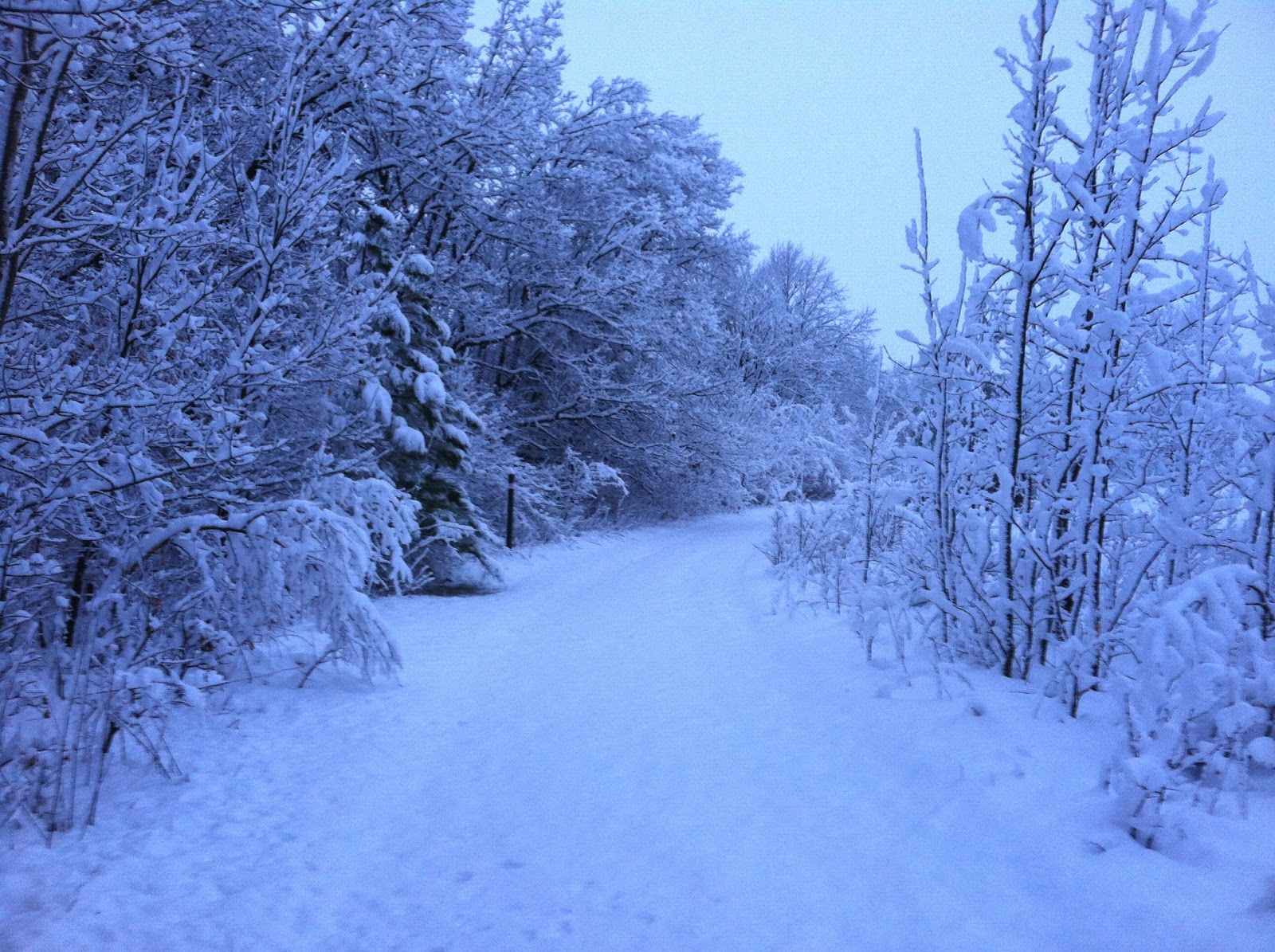
As luck would have it, Winter was NOT done in Wisconsin.  Another dumping of about 6" of snow found Willow River State Park on the morning of May 2nd.  I love running in this state.

I took the following pictures on my morning run in the park.  With scenes like these, Spring can take its time.  Enjoy!

The path into the park; 6 inches deep!

The steps to the North observation overlook

The view from the overlook; the picture does not do the scene justice

Willow River, at the Falls Bridge